


In short
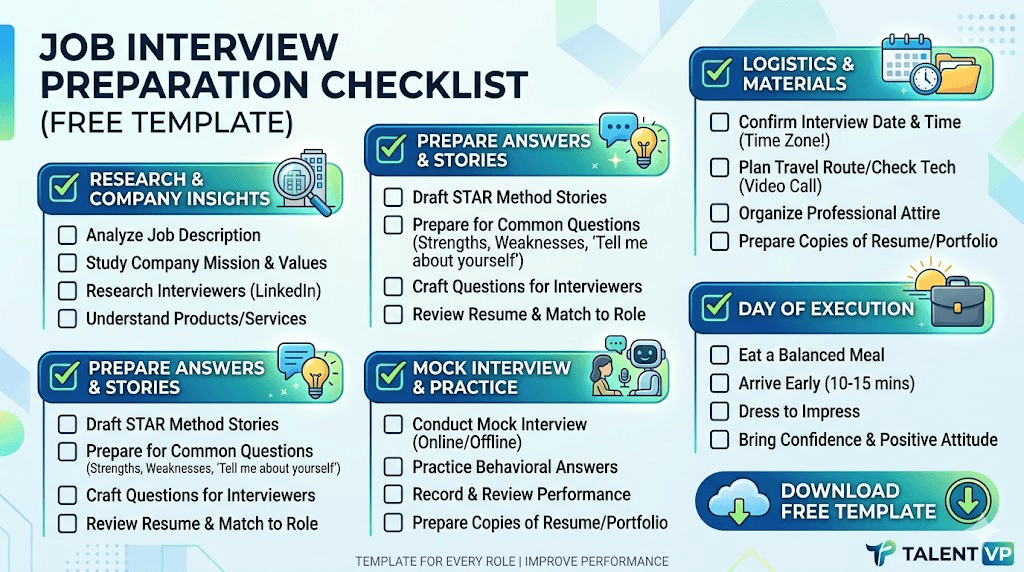
- Before an interview you need five things done: research, stories, questions, logistics and a plan for the day.
- Each item below has a "done when" line, so you know when you can tick it off.
- The item most people skip is saying their answers out loud once before the real thing.
You have an interview invitation and a vague feeling that you should "prepare". This job interview preparation checklist turns that feeling into a list you can finish. It answers one question: what exactly do you need to have done before the interview starts?
The checklist itself is the template. Copy the tables into your notes app or print the page, and tick off each line. Every item comes with a "done when" so you are not left guessing whether it counts.
How to use this job interview preparation checklist
The list has five phases. Work through them in order, because later phases build on earlier ones. Your stories are easier to choose once you know what the job ad asks for. Your questions are better once you have done the research.
You don't need a fixed schedule. If the interview is in a week, spread the phases out. If it is tomorrow, do research and stories first and keep the rest short.
A checklist item is only done when you can show the result, not when you have thought about it.
Phase 1: Research
The goal is to connect what the company needs with what you have done.
| Item | Done when |
|---|---|
| Read the job ad line by line | You have marked the 3 to 5 requirements that appear most often or first |
| Map your experience to those requirements | Each marked requirement has one example from your work next to it |
| Read the company website and recent news | You can say in two sentences what the company sells and to whom |
| Look up your interviewers if you know their names | You know their roles and which team you would join |
| Find your honest reason for this company | You have one specific sentence that would not fit a competitor |
| Check the interview format and length | You know if it is video, phone or on site, and roughly how long |
The last research item feeds your "Why this company?" answer. Here is an illustrative before and after:
| Version | Answer |
|---|---|
| Weak | You seem like a solid company and the role sounds interesting. |
| Stronger | Your team is moving its reporting to a new platform, and I led that kind of migration in my last role. |
The stronger version names something real about the company and links it to one thing you did.
Phase 2: Your stories
Most interview questions are invitations to tell a short story. Prepare the stories, not the exact wording.
| Item | Done when |
|---|---|
| Prepare your "Tell me about yourself" answer | It covers present role, relevant past and why this job, in about two minutes |
| Pick four to six work stories | You have stories for a conflict, a mistake, a result you are proud of and working under pressure |
| Structure each story with STAR | Each one has Situation, Task, Action and Result, with your own role clear |
| Give every story a result | Each story ends with an outcome you can name, ideally a number or a visible change |
| Prepare "Why are you leaving?" | Your answer looks forward and does not complain about your current employer |
| Decide your salary range | You have a range you can say out loud if asked |
| Say each answer out loud once | You have spoken every story at least once, not only read it |
The story you can say out loud is the only one you have actually prepared.
A story without a result is the most common gap. "We talked and it was fine" is not a result. "We shipped on time and kept the process for later releases" is one.
Phase 3: Questions to ask
Most interviews end with "Do you have any questions for us?" Your answer tells the interviewer how seriously you have thought about the role.
| Item | Done when |
|---|---|
| Write two questions about the role | You could ask what success looks like after the first months |
| Write one question about the team | You could ask how the team works together or makes decisions |
| Write one question about next steps | You know you will ask about the timeline and the next stage |
| Remove questions the website already answers | None of your questions can be answered with a quick search |
| Keep one spare question | You have a backup if your best question is answered during the interview |
Phase 4: Documents and logistics
Small practical problems cost attention you need for your answers. Remove them the day before.
| Item | Done when |
|---|---|
| Reread the CV you sent | You can explain every line on it, including dates and gaps |
| Keep the job ad and your notes at hand | Both are open or printed, ready for a last look |
| Prepare documents if asked | Certificates, portfolio or references are ready in the format requested |
| Test your setup for a video interview | Camera, microphone, light and the meeting link worked in a test call |
| Plan your route for an on site interview | You know the address, travel time and who to ask for at reception |
| Choose your clothes | Your outfit is ready and fits what you saw of the company culture |
| Save the interviewer's contact details | You have a phone number or email in case you are delayed |
Phase 5: The day of the interview
On the day, you are not learning anything new. You are only making it easy to use what you prepared.
| Item | Done when |
|---|---|
| Review your story list once | You have read the headlines of your stories, not full scripts |
| Join or arrive a little early | You are logged in or at reception about ten minutes before the start |
| Have water, a pen and paper ready | You can take notes without searching for something |
| Ask about the time available if unclear | You know how long you have, so you can size your answers |
| Close with your questions and next steps | You have asked at least one question and know what happens next |
| Write down notes right after | You have noted the questions asked and what you would answer differently |
Preparation does not remove nerves. It gives your nerves less to work with.
The item most people skip
Almost everyone does the research. Far fewer say their answers out loud before the interview. Yet that is where most problems show up: a story that runs too long, a result you forget to mention, an opening that wanders.
A mock interview lets you tick that box properly. In TalentVP, a mock interview has seven questions. The first is an opener, and in the last one you ask the questions, which is good practice for Phase 3. The five in between are generated from the job title, your seniority, the job ad text and your earlier answers.
You can type or speak your answers. Spoken answers are transcribed and scored as text. Each answer gets a score from 0 to 100, strengths, areas to improve and a model answer, using STAR, PAR or CARL as the structure. Interviews run in English, German or Turkish. A free account includes one mock interview.
If you want a day-by-day plan rather than a checklist, read How to Prepare for a Job Interview, which walks through the preparation timeline from invitation to follow-up.


