


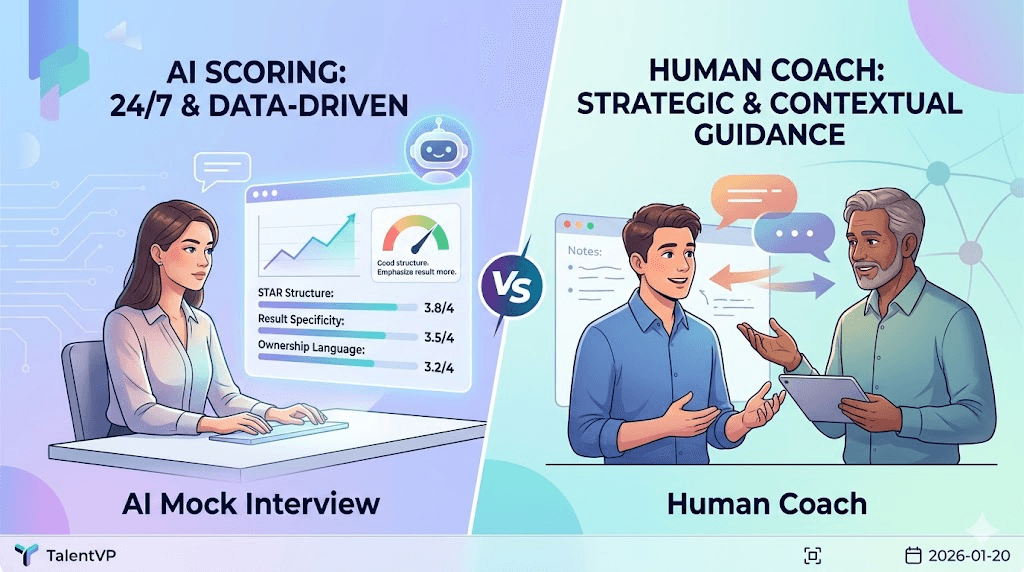
In short
- An AI mock interview is best for repetition: many attempts, any time, with feedback on the structure of every answer.
- A human coach is better at what AI can't see or know: body language, your industry, and keeping you accountable.
- Start with AI to fix the basics. Book a coach when the stakes are high or the problem is not the words.
Your interview is in ten days. You know you should practise, and you see two options. One is an AI mock interview you can start tonight. The other is a human coach who costs money and has a calendar.
This article answers one question: which one should you use, and when is each worth it? You'll get a side-by-side comparison, the situations where a coach clearly wins, and a simple way to decide.
The short answer
They are not substitutes. They solve different problems.
An AI mock interview is a practice tool. It asks questions, listens to or reads your answers, and gives feedback straight away. Its strength is volume: you can answer the same question five times in an evening.
A human coach is a person who watches you, asks follow-up questions, and adjusts the session to you. Their strength is judgement: they notice things you didn't say and know things a tool doesn't.
Practice fixes how you answer. A coach helps you decide what to say and how you come across.
What an AI mock interview does well
Repetition without a calendar
Most interview problems are fixed by answering again, not by reading more. An AI mock interview lets you practise at 11 pm on a Sunday, ten minutes at a time, as often as you need.
Feedback on structure, every time
A good tool checks each answer against a structure such as STAR (Situation, Task, Action, Result). It tells you when the result is missing or your own role is unclear. That is the most common gap in behavioural answers, and it is easy to see once someone points at it.
Low pressure for early attempts
Your first answers to hard questions are usually messy. Many people prefer to get through those first rough versions alone, without anyone watching.
Practice in the language of the interview
If your interview is in German or English and that is not your first language, extra speaking practice in that language helps. A tool doesn't get tired of the tenth attempt.
What a human coach does better
Body language and presence
Most AI mock interview tools assess what you say, not how you look while you say it. A coach sees posture, eye contact, nervous habits and how you handle silence. If your answers are fine on paper but you freeze in the room, that is a coach's job.
Industry and company insight
An experienced coach may know how interviews run in your field: what a panel tends to probe, how a case round works, which signals matter in that culture. A tool only knows what you give it, such as the job ad.
Follow-up questions that go off script
Real interviewers dig. "Why that decision? What would you do differently?" A coach can push on the weak spot in your story the way an interviewer would.
Accountability
A booked session is a commitment. If you tend to postpone practice, a person waiting for you on Thursday is a strong reason to show up prepared.
Strategy beyond single answers
Career change, a gap in your CV, a salary conversation, positioning yourself for a senior role: these are about the whole story, not one answer. A coach can help you shape that story.
A tool can tell you the result is missing. It can't tell you whether this is the right story for this company.
AI mock interview vs human coach: side-by-side comparison
| Criterion | AI mock interview | Human coach |
|---|---|---|
| Availability | Any time, no booking | By appointment |
| Cost | Often free to start, then a subscription or pass | Varies widely, usually paid per session |
| Number of attempts | As many as you want | Limited by session time and budget |
| Feedback on answer structure | Yes, after every answer | Yes, depending on the coach |
| Body language and presence | Usually not assessed | Yes, especially in person or on video |
| Industry and company insight | Limited to what you enter | Depends on the coach's experience |
| Follow-up questions | Within the tool's question flow | Flexible, can dig into weak spots |
| Accountability | Up to you | Built in through appointments |
| Pressure | Low | Closer to a real interview |
| Consistency of quality | Same tool every time | Varies from coach to coach |
Two notes on this table. First, AI feedback is generated by a model. Treat it as a second opinion on structure, not as the truth about your chances. Second, "coach" is not a protected title, so quality varies. Ask about relevant experience before you book.
When each one is worth it
Use an AI mock interview when
- you have not practised out loud yet and need to get through the rough first versions
- your main problem is structure: rambling, no clear result, unclear role
- you want to practise many times before a specific interview
- your budget is tight, or the interview is soon and no coach is available
A human coach is worth it when
- the stakes are high: a senior role, a long process, or a job you really want
- your answers read well, but nerves, presence or body language let you down
- you need industry-specific insight, for example for case or panel interviews
- you are changing careers or need to explain something difficult in your story
- you know you won't practise unless someone holds you to it
Using both: the order matters
If you use both, practise with AI first. Go to the coach with your basic answers already structured. Then the paid session is spent on the things only a person can do, not on discovering that your answers have no result.
Don't pay a coach to tell you what a free practice round would have shown you.
An illustrative example
The following scenario is illustrative, not a real candidate.
A product manager has a final-round panel interview in two weeks. In her first AI mock interview, the feedback keeps pointing at the same gap: she describes what the team did, but not what she did or what changed as a result. Over a few evenings she fixes that and answers the same questions again.
Her answers are now clear. What still worries her is the panel itself: four people, a case discussion, and a manager known for pushing back. She books one session with a coach who has run panel interviews in her industry. The coach plays the tough interviewer, works on how she handles interruptions, and helps her pick which project to lead with.
Each option did the part it is good at.
What a TalentVP mock interview covers
A TalentVP mock interview has seven questions. The first is an opener. In the last one the roles switch and you ask the questions. The five in between are generated from the job title, your seniority, the job ad and your earlier answers.
You can type or speak your answers. Spoken answers are transcribed and assessed as text, so the tool does not assess body language. Interviews run in English, German or Turkish.
After each answer you get a score from 0 to 100, strengths, areas to improve and a model answer, structured as STAR, PAR or CARL. Your dashboard shows past interviews and how your scores change. A free account includes one mock interview.
If you've decided to start with AI practice, AI Interview Preparation: A 7-Step Method shows how to get the most out of each attempt.


